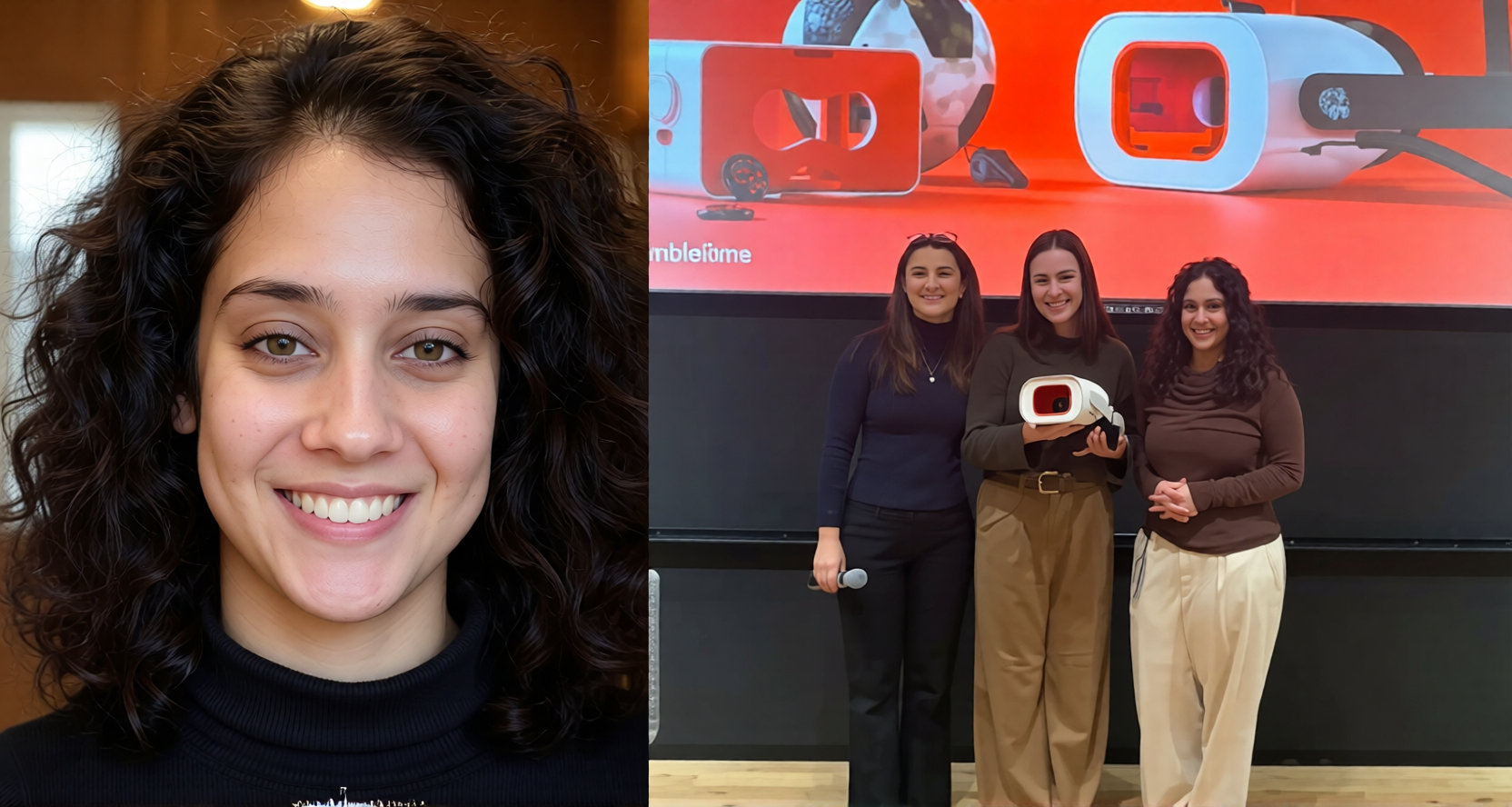
Radhika Saran and her team win the 2026 James Dyson Award for an innovation designed to make early concussion screening more accessible
Massachusetts: An Indian-origin student associated with Harvard University, Radhika Saran, along with her teammates Cleo Pontone and Sophia DeVito, has developed an affordable device that could help identify potential brain injuries among athletes. Their innovation, named Rumble Rims, has received the prestigious 2026 James Dyson Award.
The device is designed to make preliminary screening for possible brain injuries quicker and more accessible, particularly in schools, sports academies and institutions that lack specialised medical facilities.
Rumble Rims is a lightweight, head-mounted device that uses infrared cameras to monitor eye movements. During a test, the user follows a visual target while the device records and analyses eye movement patterns, attention and response-related indicators. The screening takes approximately two to three minutes, allowing coaches and medical personnel to identify signs that may warrant further medical evaluation.
One of the device’s key advantages is its affordability. Priced at less than $350, it is intended to offer a relatively low-cost option compared with conventional specialised medical equipment. This could make preliminary screening more accessible to smaller sporting institutions and facilities in areas with limited healthcare infrastructure.
Head injuries are a major concern across several sports, including football, cricket, boxing, wrestling and hockey. Collisions, falls and repeated blows to the head can cause concussions and other traumatic brain injuries. Symptoms may not always become apparent immediately and can include headaches, dizziness, confusion, fatigue, memory problems and difficulty concentrating.
Young athletes require particular attention, as head injuries during their developmental years can have serious consequences if left unassessed. In many cases, players continue participating in sporting activities because they underestimate the seriousness of an injury.
A device such as Rumble Rims could help coaches and sports administrators identify athletes who may need medical attention. Its potential applications extend to schools, colleges, local sporting competitions and professional training centres.


However, the device is intended as a preliminary screening aid and cannot replace a clinical examination or provide a definitive diagnosis of brain injury. Athletes suspected of having sustained a concussion must undergo appropriate medical assessment.
The recognition at the 2026 James Dyson Award highlights the team’s attempt to address a practical healthcare challenge through accessible technology. It also brings international attention to the contribution of young Indian-origin innovators in scientific research and product development.
The development comes at a time when participation in organised sports is expanding across India, including in smaller towns and rural areas. As more young people pursue careers in sports, ensuring access to basic medical support and injury assessment is becoming increasingly important.
Sports institutions need to give player safety the same attention as training and performance. Access to first-aid facilities, trained medical personnel and appropriate injury-screening systems can help reduce the risks associated with playing through an undetected injury.
Radhika Saran and her team’s work also highlights the importance of encouraging young researchers to develop solutions to real-world problems. Greater access to research facilities, technical guidance and opportunities for experimentation can help students translate their ideas into practical innovations.
While the device will require appropriate scientific validation and wider evaluation before its use can be established across sporting institutions, its central objective is clear: making early identification of potential brain injuries more accessible and affordable.
The achievement sends a message to young innovators that scientific research can address everyday challenges and contribute directly to public safety. In sport, where physical performance often receives the greatest attention, protecting the long-term health of athletes remains equally important.











 https://www.youtube.com/watch?si=RtToJsBhYBatUrym&v=mOuYNSdhjHA&feature=youtu.be